
Some online mental health tests are accurate. A good mental health test can show that your symptoms follow a pattern worth investigating. But it cannot tell you whether you have a condition or not. And that gap matters more than any score.
Most of these tests rely on questionnaires researchers have studied for years. The rest are just clickbait with no real research to back them up. So when you are lying in bed wondering whether an online mental test you just took is accurate, remember that accuracy varies from one test to another.
Screening vs Diagnosis: Why the Difference Matters
People often mix these two terms, and that is okay. We are here to tell you they’re not the same at all.

Screening
A screening tool asks everyone the same question. Your answers add up to a score, and then that score shows whether your symptoms are similar to what’s seen in a certain condition.
That is all that a mental health self-assessment really does. It just suggests this might be worth a closer look.
Diagnosis
A diagnosis is a different world altogether. A doctor or a psychologist sits with you. They talk and ask you things that no quiz would ever ask. They do a healthcare assessment that is aligned with your health history and daily life. Then they reach a conclusion.
How Accurate Is Mental Health Screening? Sensitivity, Specificity and False Positives
Researchers measure screening accuracy with two parameters: sensitivity and specificity. Sensitivity measures how well a test catches people who do have a condition. If sensitivity is low, some diagnoses can slip through. Specificity measures how well the test clears people who don’t have the condition. Low specificity can even flag healthy people.
No test nails both every time. So you end up with two kinds of mistakes: false positives and false negatives. A false positive is when the result says “possible condition”, but when assessment occurs, there is nothing to explore. A false negative is when the result looks fine, but you are struggling with symptoms.
This is one reason false positives aren’t rare. This mainly happens because screening tools are in a hurry to catch more and more people, and very few of them turn out to be true. It also explains why a clear result shouldn’t keep you from getting help if you still feel off.
What Makes an Online Test Trustworthy?
If a test uses a validated questionnaire, it’s more likely to be trustworthy. Using a validated questionnaire means researchers tested it with a large group and compared it with a clinical assessment, so they know it measures what it claims and produces consistent results.
A mental health screening questionnaire like that is a lot more reliable than a mental health quiz someone put together over lunch.
Here are a few things that you should look for before you trust an online mental health assessment:
- It tells you which condition it screens for.
- It says clearly that it isn’t a diagnosis.
- It doesn’t promise answers from five questions.
- It sends you to a professional afterwards
If it fails most of these parameters, treat it like a magazine quiz and move on.
Are Online ADHD Tests Accurate?
ADHD is one of the most searched topics and one of the easiest to get wrong. Here is what a decent screener can do. It can show you whether your focus, restlessness, and impulsiveness are worth raising with a clinician. But it can’t confirm ADHD.
This is mainly because bad sleep, stress, anxiety and low mood can all make concentration a bit difficult. A short quiz often lacks that nuance. Adulthood tends to add another layer on top ot it all because ADHD often looks different once you are past childhood.
Because a proper ADHD assessment will not just focus on the past month. It will cover most of your life, your routine, and more. And it is a bit difficult to pack all that in just 10 or 20 questions.
Why a Good Test Can Still Get It Wrong
ADHD is one of the most searched topics and one of the easiest to get wrong. Here is what a decent screener can do. It can show you whether your focus, restlessness, and impulsiveness are worth raising with a clinician. But it can’t confirm ADHD.
This is mainly because bad sleep, stress, anxiety and low mood can all make concentration a bit difficult. A short quiz often lacks that nuance. Adulthood tends to add another layer on top ot it all because ADHD often looks different once you are past childhood.
Because a proper ADHD assessment will not just focus on the past month. It will cover most of your life, your routine, and more. And it is a bit difficult to pack all that in just 10 or 20 questions.
Is a Free Mental Health Test in Australia Worth Using?
Often, yes. A free mental health test in Australia can give you a starting point, especially if you are not sure whether your problems are serious enough. The catch is choosing the right test, one that’s trustworthy and worth your time and effort.
A free test from a trusted health service is more likely to use a recognised questionnaire than one on a random site. You can also check how they store and assess your answers, since you are handing over your personal health information.
You can also take a free online psych evaluation test. Keep in mind that a quiz can’t replace a psychological evaluation. At best, it tells you whether booking one makes sense.
Is a Free Mental Health Test in Australia Worth Using?
It’s not the score that matters. It’s what you do afterwards that makes all the difference. First, take a minute for yourself. Remember that a high score isn’t a label, and a low one isn’t a guarantee. Then write down what you have noticed so far:
- What the symptoms are
- How long they have been around
- Where they get in your everyday life
- Whether they interfere with your work, sleep or relationships
Take that list and your result to a GP or mental health professional. Don’t present it as proof. Use it to get the chat started. From there, ask about a clinical assessment, which can lead to a diagnosis and a plan.
Moreover, if something feels urgent, do not wait. Call 000 if you’re in danger, or Lifeline on 13 11 14 if you’re having thoughts of harming yourself.Whatever the result says, feeling unwell is reason enough to talk to someone.
What Happens in a Clinical Assessment?
Clinical assessment is the real fix for the accuracy problem, so it helps to know what to expect.
Most of the time, the clinician talks through your symptoms, history, day-to-day life, and sometimes (if necessary) your family background. They might use validated questionnaires, but only as one part of the conversation. Then they pull it all together, reach a conclusion and go through treatment options with you.
That’s how an assessment can catch things a quiz never could, like overlapping conditions, a medical cause, or stress from something that happened recently.
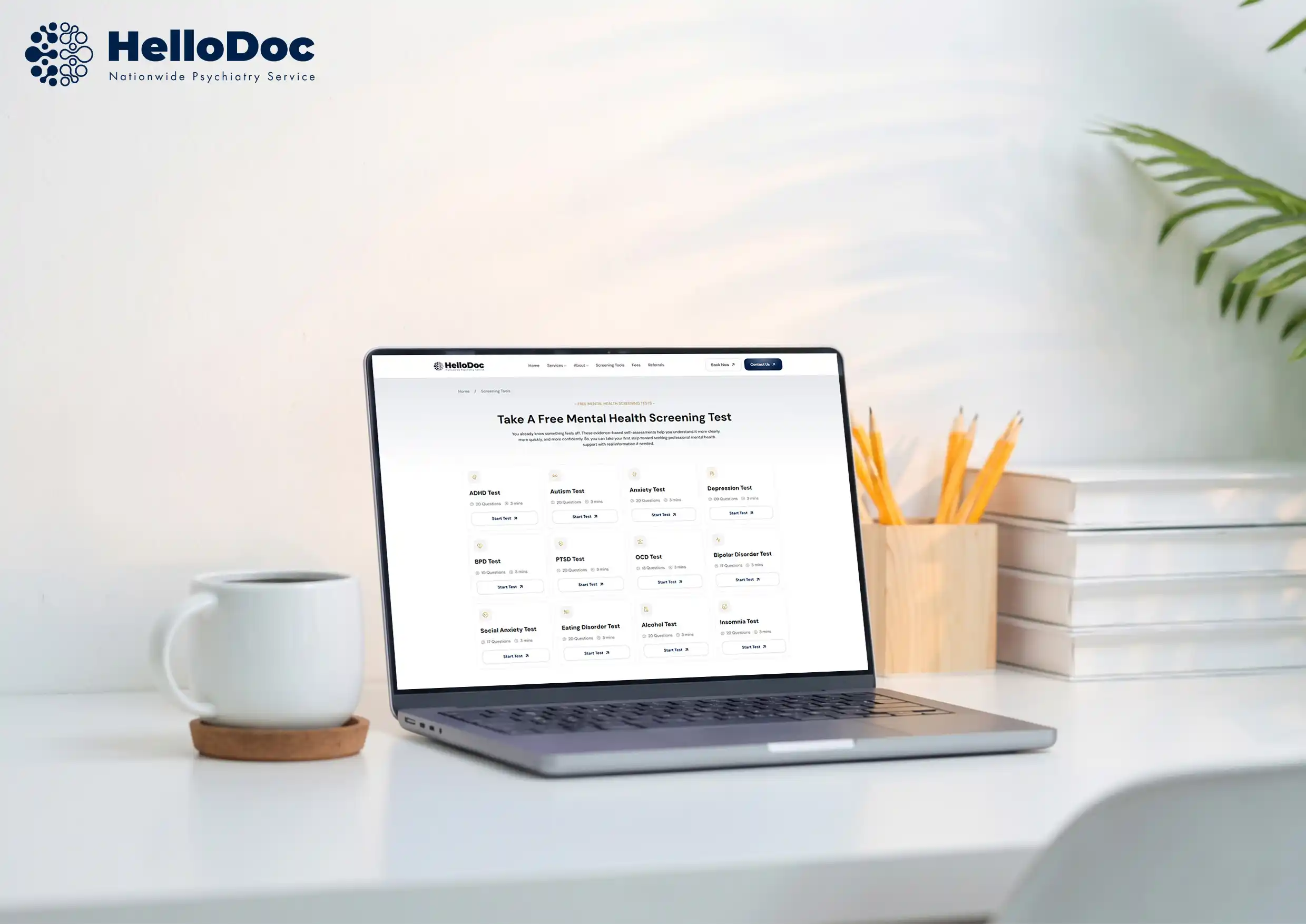
Some Major Screening Tools That You Should Know About
If you’d like to start with a screening tool, these are the main ones. Remember, each screening tool is just a starting point, and none can replace an expert opinion.
-
ADHD Test: Covers attention, focus, impulsivity and restlessness.
-
Autism Test: Asks about social communication, sensory sensitivities and routines.
-
Anxiety Test: Checks how often worry, tension and fear get in the way of daily life.
-
Depression Test: Goes over low mood, loss of interest, and changes in sleep or energy.
-
BPD Test: Looks at intense emotions, unstable relationships and shifts in self-image.
-
PTSD Test: Asks about reactions that can follow a frightening or distressing event.
-
OCD Test: Picks up repeated unwanted thoughts and the urge to repeat certain actions.
-
Bipolar Disorder Test: Covers swings between high-energy and low-mood periods.
-
Social Anxiety Test: Explores fear of being judged in social or performance situations.
-
Eating Disorder Test: Goes over thoughts and habits around food, weight and body image.
-
Alcohol Test: Checks your drinking patterns and whether alcohol may be causing harm.
-
Insomnia Test: Covers trouble falling or staying asleep, and tiredness during the day.
From Online Result to Real Answers
So, you’ve taken a test, you’ve read what it can and can’t tell you, and you’re still left with a result. That’s usually the point where people get stuck. Because a score can feel too big to ignore, but not big enough to book an appointment over.
This is where HelloDoc can help. Instead of guessing what your result means, you can book an online appointment and talk it through with a doctor who’ll consider your symptoms, history, and day-to-day life.
You can also share your notes with your doctor, which makes a handy starting point and means you won’t have to explain everything from scratch. You can book an appointment with HelloDoc whenever you feel ready, even if you’re not sure it’s “serious enough.
Frequently Asked Questions
Can an online test diagnose a mental health condition?
No. It can only show that your symptoms match a pattern worth exploring, but only a qualified professional can make a diagnosis.
Why did my result say I might have a condition when I feel fine?
It could be a false positive. Screening tools are designed to flag as many possible cases as possible, so some people get flagged and later find out, after a full assessment, that they don’t need a diagnosis.
Should I trust a negative result?
You should take it as useful information but not as the last word. If your symptoms still affect your life, talk to a professional.
Is it safe to share my answers online?
That mainly depends on the website. To assess that, check how the site stores your data and who can see it before you start.
Final Thoughts
Online mental health tests aren’t magic, and they aren’t useless either. Used well, they can help you spot patterns, understand complications, and find the right words for what you are feeling. But if you just use them on their own, they can leave you with more questions than you started with.
So if a result has been bugging you, treat it as a nudge, not a verdict. The next step is a conversation with someone who can look at the whole picture with you. Remember that reaching out isn’t an overreaction, and you don’t have to wait until things get worse.
HelloDoc (Disclaimer and Liability Terms)
HelloDoc aims to connect users with psychiatry professionals. However, we do not guarantee the accuracy, reliability, or completeness of the information shared. The platform does not warrant any professional medical advice, diagnosis, or treatment. All services are offered “as-is,” and users must assess their relevance independently.
HelloDoc is NOT an emergency response platform. All consultations are by appointment only. If you are experiencing a mental health crisis, please seek immediate assistance from emergency services.
For Mental Health Emergencies in Australia, contact:
- Lifeline: 13 11 14
- Beyond Blue: 1300 224 636
- MensLine Australia: 1300 789 978
- Suicide Call Back Service: 1300 659 467
- Veterans and Veterans Families Counselling Service: 1800 011 046
The information on this website, including blog posts, is for general informational purposes only and is not meant to replace or substitute for professional medical advice, diagnosis, or evidence-based treatment. Always consult a qualified healthcare provider for any medical condition or health-related questions. By continuing to use HelloDoc, you accept these terms and acknowledge that they may change without notice.