
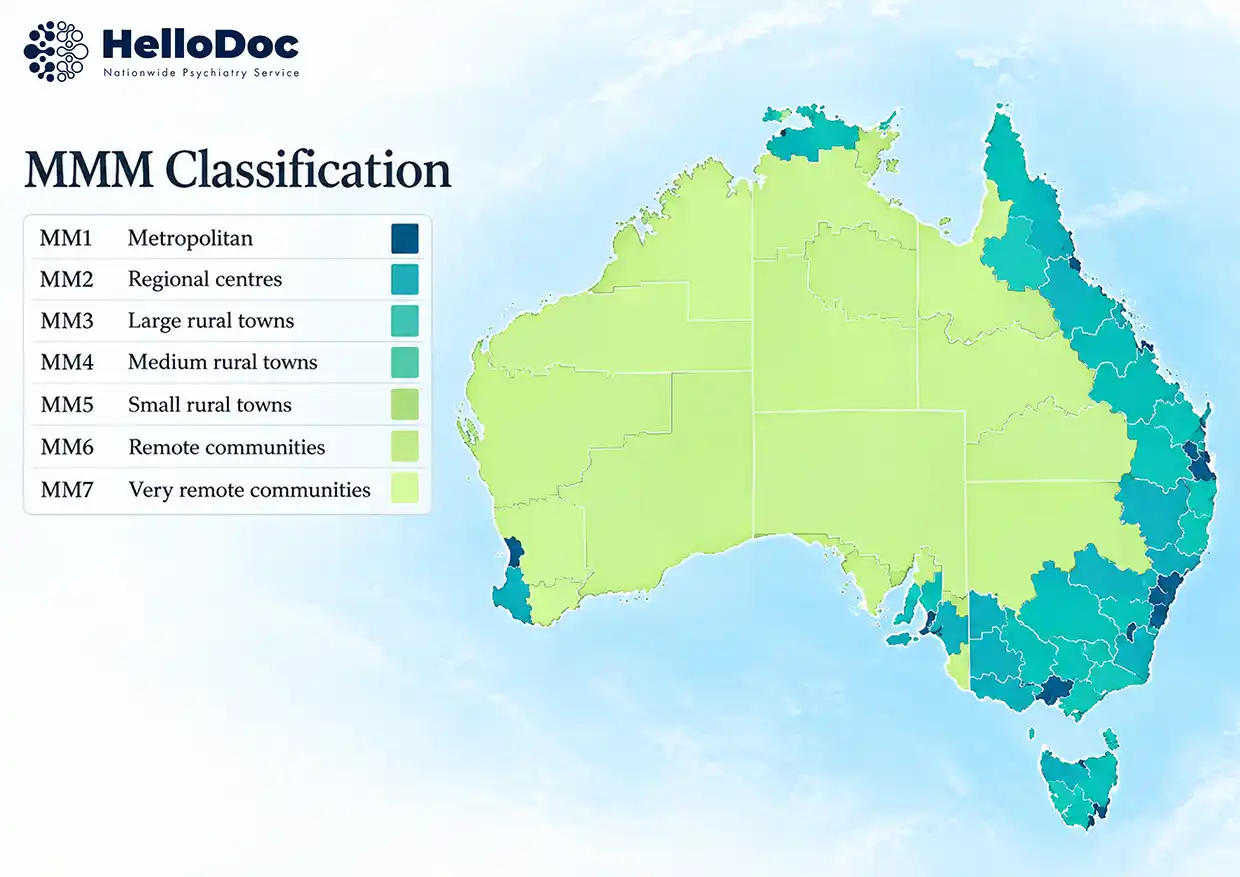
Access to healthcare can vary widely across Australia. A patient in a major city may find several nearby GPs, while a remote community may have fewer local options.
The Modified Monash Model (MMM) helps explain these differences. It classifies Australian locations according to geographical remoteness and the size of nearby towns.
The classification also influences government decisions about healthcare funding and workforce distribution. Understanding the MMM can help patients, doctors, and medical practices navigate Australia’s healthcare system.

This guide explains MM1 to MM7, how to check an address, and why the classification matters.
What Is the Modified Monash Model?
The Modified Monash Model is an Australian Government geographical classification system. It identifies whether an area falls within a metropolitan, regional, rural, remote, or very remote category.
The Department of Health, Disability and Ageing uses the model to help direct healthcare professionals towards communities with greater access challenges. The system considers the Australian Bureau of Statistics’ remoteness areas, road distances between towns, and town population sizes.
The model uses seven categories, from MM1 to MM7. MM1 represents metropolitan areas, while MM7 represents very remote communities.
The government uses the classification to determine eligibility for various rural health workforce programs and incentives. These programs aim to attract and retain healthcare professionals in communities that may struggle to recruit and retain staff.
The current 2023 MMM classification uses 2021 Census data. Services Australia implemented this version for health workforce programs on 13 April 2025.
You can check the classification for a specific location through the Australian Government’s Health Workforce Locator. The tool also displays other workforce classifications, including Distribution Priority Area status.
What Do MM1 to MM7 Mean?
The MM classification indicates how metropolitan, regional, rural, or remote an area is. Higher numbers generally indicate greater geographical remoteness, but the categories also consider town size and location.
The distinction matters because two towns with similar populations may fall into different categories. Their geographical remoteness and distance from larger centres can affect their classifications.
The table below summarises all seven categories under the 2023 Modified Monash Model.
MM Category | Classification | Description |
MM1 | Metropolitan | Major cities and metropolitan areas. |
MM2 | Regional centres | Within 20 km of towns over 50,000 people. |
MM3 | Large rural towns | Within 15 km of towns with 15,000–50,000 people. |
MM4 | Medium rural towns | Within 10 km of towns with 5,000–15,000 people. |
MM5 | Small rural towns | Remaining Inner and Outer Regional areas |
MM6 | Remote | Areas classified as Remote Australia. |
MM7 | Very Remote | Areas classified as Very Remote Australia. |
MM1: Metropolitan Areas
MM1 covers metropolitan areas, including all locations within the ASGS-RA1 classification. These areas generally have greater access to hospitals, medical practices, and specialist services.
However, metropolitan classification does not guarantee that every patient can access affordable or timely healthcare. Local demand, service availability, and individual circumstances still matter.
MM2: Regional Centres
MM2 includes qualifying regional areas within a 20 km drive of a town with more than 50,000 residents. Examples include Ballarat, Mackay, Toowoomba, and Bunbury.
These centres may offer a wider range of services than smaller rural towns. However, residents in surrounding communities may still face travel barriers when seeking specialised care.
MM3: Large Rural Towns
MM3 covers qualifying regional areas within a 15 km drive of towns with populations between 15,000 and 50,000. Examples include Dubbo, Lismore, and Busselton.
These towns provide important healthcare services to surrounding populations. However, local specialist availability and access to advanced treatment can vary.
MM4: Medium Rural Towns
MM4 includes qualifying regional areas within a 10 km drive of towns with populations between 5,000 and 15,000. Examples include Port Augusta, Moree, and Charters Towers.
These towns often serve smaller communities across wider rural areas. Residents may need to travel further for some specialist appointments or hospital services.
MM5: Small Rural Towns
MM5 covers the remaining areas classified as Inner Regional or Outer Regional under the Australian Statistical Geography Standard. These locations fall outside the MM2, MM3, and MM4 town-based criteria.
Small rural communities may have fewer local healthcare services. Residents can face longer journeys when they need specialist consultations or services unavailable nearby.
MM6: Remote Communities
MM6 covers areas classified as Remote Australia, along with specified offshore islands. The classification also includes certain small islands without mainland bridges under the applicable MMM rules.
Remote locations can face substantial recruitment and retention challenges. Long travel distances, limited transport options, and smaller local workforces can complicate access to healthcare.
MM7: Very Remote Communities
MM7 covers areas classified as Very Remote Australia and qualifying offshore islands more than 5 km from the mainland. Examples include Longreach, Coober Pedy, and Thursday Island.
These communities can face significant barriers to accessing healthcare. Distance, transport limitations, and difficulties recruiting health professionals can affect the availability of local services.
Important: The examples above illustrate the classification system. A town name alone cannot confirm the MM category of every address within that locality. Always check the specific address using the official locator.
Why Does the Modified Monash Model Matter for Healthcare?
The MMM does more than describe Australia’s geography. It helps determine where government programs direct resources and which locations qualify for particular healthcare workforce incentives.
1. It Helps Address Rural Healthcare Workforce Gaps
Some regional and remote communities struggle to recruit and retain GPs and other healthcare professionals. Smaller populations, professional isolation, and long travel distances can make recruitment more difficult.
The government uses MMM classifications to target programs that encourage doctors to train and work in eligible locations. Depending on the program, these measures can include financial incentives, training opportunities, or other workforce assistance.
Eligibility varies by program. A particular MM category does not automatically qualify every doctor or practice for every available benefit.
2. It Affects Rural Bulk Billing Incentives
The Rural Bulk Billing Incentive (RBBI) provides additional Medicare payments to eligible medical practitioners for qualifying bulk-billed services. The incentive uses MMM classifications to account for differences in geographical remoteness.
Under the relevant arrangements, incentive payments increase with remoteness. This approach recognizes the additional challenges of delivering healthcare in rural and remote communities.
From 1 November 2025, eligibility for the RBBI expanded to include all Medicare-eligible patients, not just concession card holders and children under 16. The government also introduced the Bulk Billing Practice Incentive Program.
These changes affect how eligible practices can receive bulk billing incentives. However, an area’s MM classification does not guarantee that a practice bulk bills every patient.
Patients should confirm fees and bulk billing arrangements directly with the medical practice. The classification describes the location, not an individual provider’s billing policy.
3. It Influences Eligibility for Workforce Programs
Several government programs use MMM categories to determine eligibility for rural medical training, recruitment, and retention initiatives. The applicable requirements depend on the specific program.
For example, some programs offer incentives to GPs who work in eligible rural locations. Other initiatives may support training pathways or help practices recruit healthcare professionals.
Doctors and practice managers should check the relevant program guidelines before making employment or financial decisions. An MM category alone does not confirm eligibility.
4. It Helps Explain Differences in Healthcare Access
The MMM provides a consistent way to describe geographical remoteness across Australia. Researchers and policymakers can use the classification to assess healthcare distribution and plan services.
For patients, the classification can help explain why some communities have fewer nearby services. However, it does not measure the actual availability, quality, or affordability of every local healthcare service.
An MM6 location may have a well-equipped local clinic, while an MM1 suburb may still experience long appointment waits. The classification provides geographical context, not a complete assessment of healthcare access.
How to Check an Address Using the Health Workforce Locator
The Health Workforce Locator lets users check the geographical classification of an Australian address. It also displays workforce shortage classifications and related information.
Follow these steps to check an address.
- Open the official locator. Visit the Health Workforce Locator.
- Enter the street address. Use a numerical street address for the most reliable search results. Avoid business names, unit numbers, and shop or tenancy numbers.
- Select the correct location. Check that the displayed address matches the intended property or medical practice.
- Review the classifications. Find the Modified Monash Model result to identify the location’s MM category. Review other available classifications, such as DPA, if relevant.
- Check the relevant program rules. If you need the classification for a workforce incentive or Medicare requirement, confirm the program’s eligibility criteria.
- Verify the current classification. Use the latest official information before making employment, registration, or funding decisions.
The locator reflects the updated MMM and DPA classifications implemented for health workforce programs in April 2025. Always use the official tool rather than relying on an older map or an informal rural classification.
What Is the Difference Between MMM and DPA?
The Modified Monash Model and Distribution Priority Area (DPA) classification both help guide Australia’s healthcare workforce planning. However, they measure different things and serve different purposes.
The MMM classifies locations according to geographical remoteness and town size. The DPA identifies areas with comparatively limited access to GP services under the government’s assessment method.
Under the current DPA rules, areas classified as MM2 to MM7 automatically qualify as DPAs. MM1 inner metropolitan areas do not qualify automatically, while the Northern Territory and Tasmania receive DPA classification under the stated rules.
This means an area can have both an MM category and a DPA classification. The two labels answer different questions.
|
Feature |
Modified Monash Model (MMM) |
Distribution Priority Area (DPA) |
|
Main purpose |
Classifies geographical remoteness and town size. |
Identifies areas with a relative shortage of GP services. |
|
Main factors |
Remoteness, town population, and road distance. |
GP service levels, community demographics, and MMM geography. |
|
Common use |
Determines eligibility for various rural workforce programs and incentives. |
Helps determine where certain overseas-trained doctors can access Medicare under applicable rules. |
|
Classification result |
MM1 to MM7 |
DPA or non-DPA status, subject to applicable rules and exceptions. |
DPA status matters particularly for International Medical Graduates (IMGs) and Foreign Graduates of Accredited Medical Schools (FGAMS). Section 19AB of the Health Insurance Act 1973 restricts Medicare access for affected doctors, subject to applicable exemptions and arrangements.
Eligible doctors generally need to work in an approved location to access Medicare benefits for their services. Doctors should check their individual circumstances and current requirements before accepting a position.
A DPA classification does not mean that every GP practice in the area lacks doctors. It reflects the government’s classification method for identifying GP service shortages.
What Does MM2 Mean in Australia?
MM2 refers to regional centres under the Modified Monash Model. It includes qualifying Inner Regional and Outer Regional areas within a 20 km drive of a town with more than 50,000 residents.
Ballarat, Mackay, Toowoomba, and Bunbury are examples of MM2 centres. However, the classification can differ across locations within and around a town.
If you need to confirm an address for a job, incentive, or medical practice, check the Health Workforce Locator. Do not assume that every address in a named town has the same classification.
Regional vs Remote Australia: What Is the Difference?
Regional Australia generally includes areas outside major cities that fall within the Inner Regional or Outer Regional categories. Under the MMM, these areas can fall into MM2, MM3, MM4, or MM5.
Remote Australia corresponds to the remote geographical category and generally falls within MM6. Very Remote Australia generally falls within MM7.
The distinction reflects more than population size. Road distance, geographical isolation, and the size of nearby towns also influence the MMM classification.
The terms regional, rural, and remote can have different meanings across government programs. Always check the classification system named in the relevant eligibility rules.
Why You Should Check the Exact MM Category
An accurate MM classification can make a practical difference when assessing eligibility for healthcare workforce programs. It can also help doctors and practice managers understand which location-based incentives may apply.
However, the classification alone cannot confirm eligibility for a specific payment, training pathway, or Medicare arrangement. Each program has its own requirements, which may include professional registration, service commitments, patient eligibility, or other conditions.
Use the official Health Workforce Locator and review the relevant Department of Health guidelines before making decisions. This approach helps prevent errors caused by outdated maps or assumptions about an entire town.
Frequently Asked Questions
1. What is the Modified Monash Model?
The Modified Monash Model is an Australian Government system that classifies locations from MM1 to MM7. It uses geographical remoteness, town population, and road distance to help target rural healthcare workforce programs.
2. What do MM1 to MM7 mean?
MM1 represents metropolitan areas, while MM2 to MM5 cover qualifying regional and rural locations. MM6 represents remote communities, and MM7 represents very remote communities. Each category follows specific geographical criteria.
3. How do I find my MM category?
Open the Health Workforce Locator, enter a numerical street address, and review the Modified Monash Model result. Check the latest classification before relying on it for program eligibility.
4. Why does MM category matter for healthcare?
The MM category helps determine eligibility for various government workforce incentives and programs. It also provides geographical context for healthcare planning and helps target initiatives towards rural and remote communities.
5. What is the difference between MMM and DPA?
MMM measures geographical remoteness and town size. DPA identifies areas with comparatively limited GP services under the government’s classification method. Both systems support workforce planning, but they serve different purposes.
Final Thoughts
The Modified Monash Model provides a consistent framework for understanding geographical differences across Australia’s healthcare landscape. Its seven categories help the government target workforce initiatives and location-based incentives.
Whether you are a patient, GP, medical graduate, or practice manager, checking the correct classification can help clarify which rules apply to a location. Use the official Health Workforce Locator and consult current program guidelines before making decisions.
HelloDoc (Disclaimer and Liability Terms)
HelloDoc aims to connect users with psychiatry professionals. However, we do not guarantee the accuracy, reliability, or completeness of the information shared. The platform does not warrant any professional medical advice, diagnosis, or treatment. All services are offered “as-is,” and users must assess their relevance independently.
HelloDoc is NOT an emergency response platform. All consultations are by appointment only. If you are experiencing a mental health crisis, please seek immediate assistance from emergency services.
For Mental Health Emergencies in Australia, contact:
- Lifeline: 13 11 14
- Beyond Blue: 1300 224 636
- MensLine Australia: 1300 789 978
- Suicide Call Back Service: 1300 659 467
- Veterans and Veterans Families Counselling Service: 1800 011 046
The information on this website, including blog posts, is for general informational purposes only and is not meant to replace or substitute for professional medical advice, diagnosis, or evidence-based treatment. Always consult a qualified healthcare provider for any medical condition or health-related questions. By continuing to use HelloDoc, you accept these terms and acknowledge that they may change without notice.