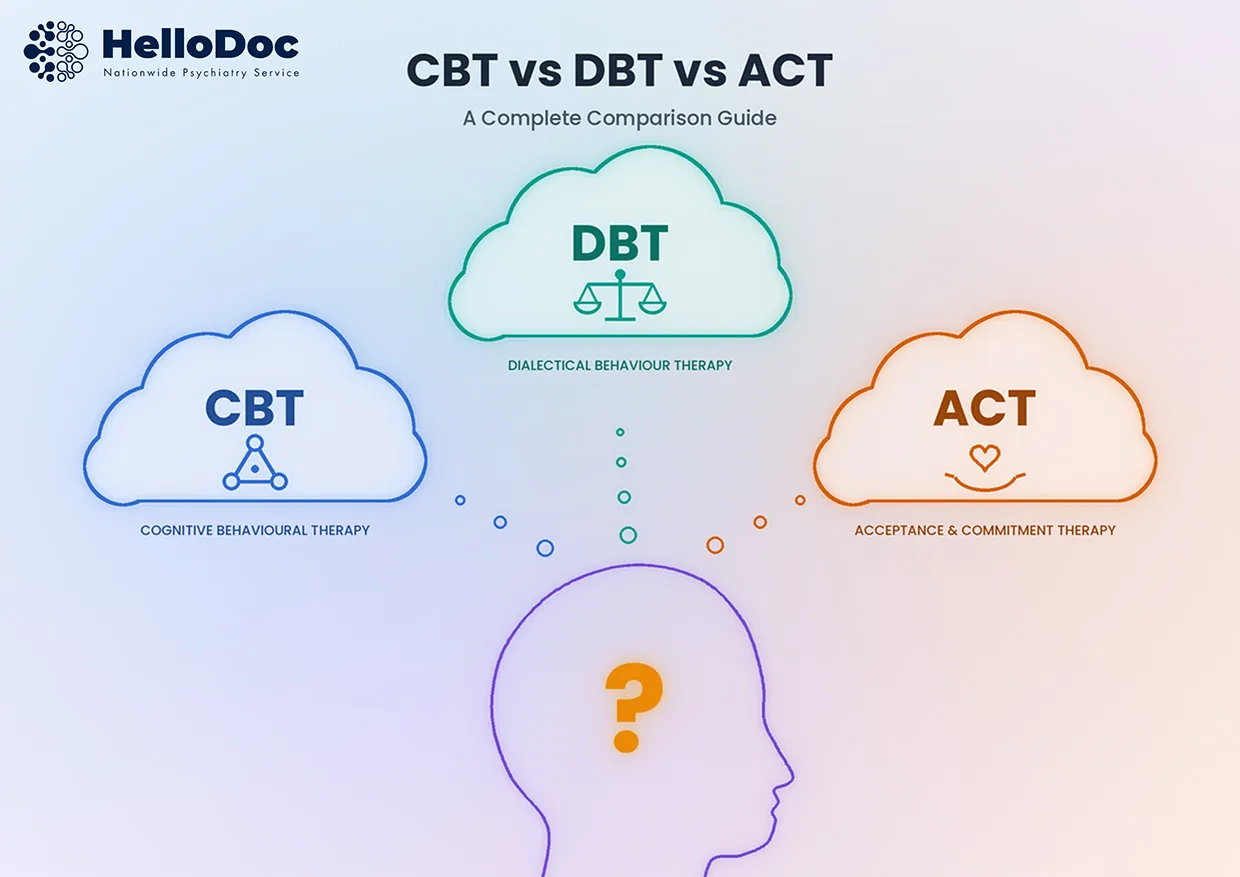
CBT vs DBT vs ACT comes down to what each therapy targets. CBT helps you change unhelpful thoughts and behaviours, DBT builds skills for managing intense emotions, and ACT helps you make room for difficult thoughts and feelings while acting on your values. All three are evidence-based, and the best fit depends on your needs, not on which therapy is “strongest” overall.
This guide compares the three types of therapy side by side: how they work, what the research says, which conditions each suits, and how they fit with Medicare in Australia. HelloDoc’s psychology services use all three approaches, often in combination.
CBT vs DBT vs ACT: Key Points
- Different approaches: CBT changes thoughts and behaviours, DBT builds emotion skills, and ACT builds psychological flexibility.
- CBT has a very extensive evidence base: it is well studied for anxiety, depression, OCD and more.
- DBT is one of the best-studied therapies for BPD: it was designed for borderline personality disorder, especially self-harm, intense emotions and relationship difficulties.
- ACT and CBT perform similarly in research: differences between them are small and depend on what is measured.
- Length varies: CBT and ACT often take a few months; a full DBT program often takes around 6–12 months, depending on the provider.
- Medicare can help: eligible people can claim rebates for up to 10 individual and 10 group services a year under Better Access.
CBT vs DBT vs ACT at a Glance
The three therapies differ in what they focus on, how they’re delivered and how long they usually take. Durations are typical ranges, not fixed rules.

Feature | CBT | DBT | ACT |
Main focus | Unhelpful thoughts and behaviours | Intense emotions, impulsive behaviour and relationships | Psychological flexibility and values-based living |
How it works | Tests thoughts, changes behaviours, gradually faces fears | Teaches four skill sets, balancing acceptance with change | Makes room for difficult experiences, steps back from thoughts, acts on values |
Typical length | About 6–20 sessions | About 6–12 months (full program) | About 8–16 sessions |
Format | Individual, sometimes group | Individual therapy plus group skills training | Individual, sometimes group |
Practice between sessions | Thought records, exposure tasks | Skills practice, diary cards | Mindfulness, values-based actions |
Best-fit conditions | Anxiety, depression, OCD, PTSD (trauma-focused), chronic pain | BPD, recurrent self-harm, emotional dysregulation | Anxiety, depression, chronic pain, stress |
Evidence | Largest and broadest | Particularly well studied for BPD | Growing; often comparable to CBT |
Fit with 10 Medicare sessions | Often a good fit | A full program usually runs longer | Often a good fit |
What Is CBT?
Cognitive behavioural therapy (CBT) is a structured, goal-focused therapy that looks at how thoughts, feelings and actions affect each other. Developed by psychiatrist Aaron Beck in the 1960s, it teaches you to spot unhelpful thinking patterns and change the behaviours that keep distress going, usually over about 6–20 sessions.
Key techniques include cognitive restructuring (checking whether a thought holds up), behavioural activation (scheduling meaningful activities when mood is low) and exposure (gradually facing feared situations). For OCD, a specialised form called exposure and response prevention (ERP) is used. One core CBT skill is challenging negative thoughts with evidence.
Example: Priya’s manager messages, “Can we talk tomorrow?” and she immediately thinks, “I’m about to be fired.” In CBT, she and her psychologist would write the thought down, weigh the evidence for and against it, and find a more balanced view. She might then test her assumption by simply asking what the meeting is about.
What Is DBT?
Dialectical behaviour therapy (DBT) is a skills-based therapy developed by psychologist Marsha Linehan for people with borderline personality disorder (BPD) who experience intense emotions and self-harm. “Dialectical” means holding two ideas together: you are doing the best you can, and you also need new skills.
DBT teaches four skill sets:
- Mindfulness: noticing thoughts and feelings without reacting automatically.
- Distress tolerance: getting through a crisis without making it worse.
- Emotion regulation: understanding and managing intense emotions.
- Interpersonal effectiveness: asking for what you need, setting boundaries and keeping relationships healthy.
A full DBT program usually combines weekly individual therapy, a weekly skills group, diary cards and between-session phone coaching, often over around 6–12 months, although length and structure vary between providers. Many psychologists also offer DBT-informed therapy, which uses DBT skills within regular sessions without the full program. Both can help, but they aren’t the same, so ask which one is being offered. Linehan’s first randomised trial, in 1991, found fewer self-harm episodes with DBT than with usual treatment.
Example: When panic and shame flood in after her manager’s message, DBT would first help Priya ride out the emotional wave, for instance by slowing her breathing and naming the emotion. Once calmer, she might practise “opposite action”: doing the opposite of an unhelpful urge, such as hiding, when that urge doesn’t fit the facts.
What Is ACT?
Acceptance and commitment therapy (ACT), developed by psychologist Steven Hayes, builds psychological flexibility: staying present, making room for uncomfortable thoughts and feelings, and acting on what matters to you. Rather than trying to remove difficult thoughts, ACT changes how you relate to them. It often runs for about 8–16 sessions, although this varies with your goals and needs.
Core ACT skills include cognitive defusion (noticing “I’m having the thought that I’ll be fired” instead of treating it as fact), acceptance, mindfulness, clarifying your values and taking small, committed steps towards them.
Example: Priya notices the anxious thought and the knot in her stomach without fighting either. She asks herself what kind of colleague she wants to be, then goes to the meeting anyway.
DBT vs CBT: What's the Difference?
CBT focuses on changing unhelpful thoughts and behaviours, while DBT adds a stronger focus on accepting emotions and building skills to manage them. DBT actually grew out of CBT: Linehan found that a focus on change alone could feel invalidating to people with very intense emotions, so she added acceptance, mindfulness and validation.
Feature | CBT | DBT |
Focus | Usually one problem at a time, such as anxiety or low mood | Works in stages, starting with safety and self-harm |
Format | Mostly individual sessions | Individual therapy, a skills group and often phone coaching |
Length | Usually shorter | A full program commonly runs 6–12 months |
For a specific anxiety problem or low mood, CBT is often the more direct option. When emotions feel overwhelming, or self-harm is part of the picture, DBT may be a better fit. Both are structured and involve practice between sessions.
ACT vs CBT: What Does the Research Say?
Research comparing ACT and CBT mostly finds they work about equally well. A 2015 review of 39 trials found ACT worked better than control conditions across several mental and physical health problems, and in the studies that compared it directly with CBT, results were generally similar. A larger 2023 review found CBT had a small edge for anxiety, while ACT scored better on short-term mindfulness measures.
The differences are small, so the best choice usually depends on you: what you’re struggling with, what you’ve tried before, and which approach feels right. Results can also vary between studies because they include different people, and therapists often have more experience in one approach than the other.
Which Therapy Is Best for Anxiety?
CBT, especially when it includes exposure, has the largest body of research for anxiety disorders and is often the first-line psychological treatment. ACT shows comparable results in many trials, and DBT skills can help when anxiety comes with strong emotional swings. The right choice depends on the type of anxiety and what you’ve already tried.
For panic, social anxiety, phobias and ongoing worry, CBT offers well-tested tools: identifying anxious predictions, testing them and gradually approaching what you’ve been avoiding. For OCD, CBT with exposure and response prevention is the most studied approach. ACT can suit people who feel stuck trying to get rid of anxious thoughts, because it focuses on living well alongside them.
Which Therapy Helps BPD?
DBT is one of the most studied therapies for borderline personality disorder, particularly for self-harm and emotional intensity. Mentalisation-based treatment (MBT) and schema therapy also have research support.
A 2020 Cochrane review of psychological therapies for BPD found that specialist therapies, mostly DBT and MBT, reduced BPD symptoms more than usual treatment, although the certainty of the evidence was low, which is common in this field. UK NICE guidance also suggests considering a comprehensive DBT program when reducing recurrent self-harm is a priority.
Only a qualified clinician can diagnose BPD. If you think it might apply to you, a GP or psychologist can assess you and talk through options.
Best Therapy by Condition
This table summarises where evidence-based therapy has the strongest support. It’s a guide, not a prescription, and individual needs vary.
Condition | Therapies with research support |
Anxiety | CBT (including exposure), ACT |
Depression | CBT, interpersonal therapy (IPT), ACT, MBCT (to help prevent depression returning) |
OCD | CBT with exposure and response prevention |
PTSD | Trauma-focused CBT, cognitive processing therapy, EMDR (delivered by a trained clinician) |
BPD | DBT, MBT, schema therapy |
Chronic pain | CBT, ACT |
Emotional dysregulation | DBT skills, ACT, CBT-based approaches |
Third-Wave Therapies and Other Types of Therapy
“Third-wave” therapies build on traditional CBT by adding mindfulness, acceptance and values. ACT, DBT and mindfulness-based cognitive therapy (MBCT) are the best-known examples. You may also hear about these other types of therapy:
- MBCT: combines CBT with mindfulness practice, mainly to help prevent depression from returning.
- Schema therapy: addresses long-standing patterns that often began early in life; usually a longer treatment.
- Mentalisation-based treatment (MBT): helps people understand their own and others’ thoughts and feelings; often used for BPD.
- EMDR: a structured therapy for traumatic memories that uses guided eye movements or other bilateral stimulation.
- Interpersonal therapy (IPT): focuses on relationships, grief and life transitions; commonly used for depression.
Can CBT, DBT and ACT Be Combined?
Yes. Many psychologists draw on more than one approach, as long as the treatment plan is clear and based on your goals. Common combinations include CBT exposure work with ACT values and defusion, or CBT with DBT emotion regulation skills. Combining doesn’t mean using every technique at once: your psychologist should be able to explain what they’re using and why.
How a Psychologist Chooses the Right Therapy
You don’t need to pick CBT, DBT or ACT before your first appointment. A psychologist usually considers:
- Your symptoms and history: what you’re experiencing, for how long, and what has helped before.
- Your goals: for example, less worry, better mood, calmer reactions or healthier relationships.
- Your preferences: some people like structured exercises; others connect more with mindfulness and acceptance.
- Practical factors: time, cost and Medicare eligibility. A full DBT program, for instance, needs a bigger time commitment.
- The relationship: feeling comfortable with your psychologist matters as much as the method.
Treatment plans are reviewed as you go, and it’s normal to adjust the approach if something isn’t working. If you’re unsure who to see first, our guide to psychiatrist vs psychologist explains the difference.
CBT, DBT and ACT With Medicare in Australia
You don’t need to pick CBT, DBT or ACT before your first appointment. A psychologist usually considers:
- Your symptoms and history: what you’re experiencing, for how long, and what has helped before.
- Your goals: for example, less worry, better mood, calmer reactions or healthier relationships.
- Your preferences: some people like structured exercises; others connect more with mindfulness and acceptance.
- Practical factors: time, cost and Medicare eligibility. A full DBT program, for instance, needs a bigger time commitment.
- The relationship: feeling comfortable with your psychologist matters as much as the method.
Treatment plans are reviewed as you go, and it’s normal to adjust the approach if something isn’t working. If you’re unsure who to see first, our guide to psychiatrist vs psychologist explains the difference.
FAQs
Is CBT or DBT better?
Neither is better for everyone. CBT has the broadest evidence for conditions such as anxiety, depression and OCD, while DBT is one of the best-studied therapies for borderline personality disorder and intense emotional distress. The better fit depends on what you’re experiencing, how much time you can commit, and what your psychologist recommends after an assessment.
Is ACT a type of CBT?
ACT is usually grouped within the wider CBT family as a third-wave therapy, but it works differently. Traditional CBT aims to change unhelpful thoughts, while ACT focuses on changing your relationship with them and acting on your values. Many psychologists draw on both.
Which therapy is best for depression?
CBT has the largest evidence base for depression, and interpersonal therapy, ACT and mindfulness-based cognitive therapy also have research support. No single therapy suits everyone, so your psychologist will consider your symptoms, history and preferences.
Can DBT help with ADHD?
Some DBT skills can help people with ADHD who struggle with emotional regulation, impulsivity or stress. However, DBT isn’t a primary treatment for the core symptoms of ADHD, which should be assessed and treated by an appropriately qualified professional.
Can I do CBT, DBT or ACT online?
Yes. CBT, ACT and DBT-informed therapy can all be delivered by telehealth. Some parts of a full DBT program, such as group skills training, depend on what the provider offers online.
What if my therapy isn’t working?
Tell your psychologist. Therapy is a collaboration, and it’s normal to adjust the approach, pace or goals. Sometimes a different method helps; sometimes the issue is timing or fit. You can also talk to your GP about a different referral.
Do I need a diagnosis to see a psychologist?
Not to see a psychologist privately. To claim Medicare rebates under Better Access, you need a Mental Health Treatment Plan from your GP, which is for people with an assessed mental health condition. Your GP can discuss this with you.
What if I don’t know which therapy I need?
That’s completely normal. You don’t need to choose before your first session. An initial assessment helps your psychologist understand your concerns and suggest an approach that suits your goals.
Mental Health Support in Australia
If you or someone you know is struggling, support is available at any time:
- Lifeline: 13 11 14 (24/7 crisis support)
- Beyond Blue: 1300 22 4636
- Suicide Call Back Service: 1300 659 467
- 13YARN: 13 92 76 (Aboriginal and Torres Strait Islander crisis support)
- Emergency: call 000 if someone is in immediate danger
HelloDoc (Disclaimer and Liability Terms)
HelloDoc aims to connect users with psychiatry professionals. However, we do not guarantee the accuracy, reliability, or completeness of the information shared. The platform does not warrant any professional medical advice, diagnosis, or treatment. All services are offered “as-is,” and users must assess their relevance independently.
HelloDoc is NOT an emergency response platform. All consultations are by appointment only. If you are experiencing a mental health crisis, please seek immediate assistance from emergency services.
For Mental Health Emergencies in Australia, contact:
- Lifeline: 13 11 14
- Beyond Blue: 1300 224 636
- MensLine Australia: 1300 789 978
- Suicide Call Back Service: 1300 659 467
- Veterans and Veterans Families Counselling Service: 1800 011 046
The information on this website, including blog posts, is for general informational purposes only and is not meant to replace or substitute for professional medical advice, diagnosis, or evidence-based treatment. Always consult a qualified healthcare provider for any medical condition or health-related questions. By continuing to use HelloDoc, you accept these terms and acknowledge that they may change without notice.