
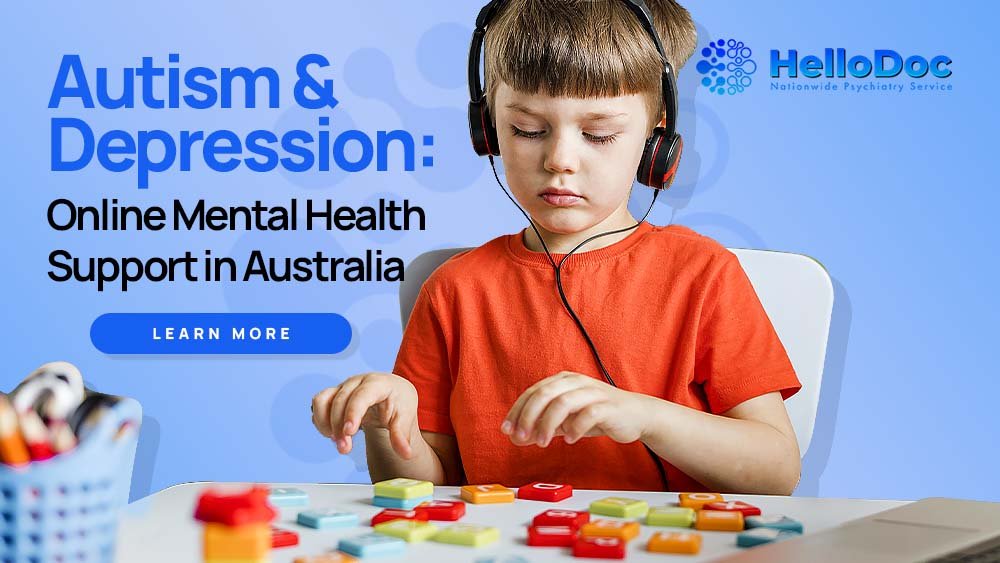
Autism Spectrum Disorder (ASD) is a developmental disorder that affects a person’s behaviour, communication, and social interactions. Although autism is not a mental health issue in and of itself, people with autism frequently experience mental health issues in conjunction with another disorder.
Depression often co-occurs with autism and comes with new problems that are not easily dealt with, such as feeling isolated and not receiving proper care. In Australia, telehealth psychiatry and psychology services now enable families and individuals to obtain their required mental health support.
HelloDoc offers dedicated mental health treatment services that focus on helping individuals with depression and autism. The first step to understanding how autism and depression connect requires us to examine both conditions, which represent distinct mental states.

What is Autism?
The permanent condition of Autism Spectrum Disorder affects the way people communicate, as well as their thinking abilities and their environmental perception. This disorder is a spectrum because every individual with autism has different characteristics. Some autistic individuals need daily help, while others can live independently and manage their daily activities and schoolwork.
Autism functions as a neurological disorder that affects how people process information. The majority of autistic people possess exceptional focus, advanced observation skills, and specialised knowledge in their respective domains.
As Autism Spectrum Australia explains, the number of Australians diagnosed with autism is increasing every year. This is particularly true for women, whose symptoms can be blamed on something else.
It is essential to consider autism as a brain-based difference, particularly when talking about mental health issues such as anxiety and depression that tend to co-occur with autism.
What is Depression?
The feeling of sadness that people experience during a difficult week represents only one aspect of depression. This condition functions as a severe mental disorder that impacts multiple aspects of human life, including mood and energy levels, sleep patterns, and daily activities. Depression makes even basic activities extremely difficult.
Australia sees depression as one of its most prevalent mental health disorders. Beyond Blue and other organisations report that most Australians may develop depression at some point in their lives.
Depression may include:
- Persistent low mood
- Loss of interest in activities
- Changes in sleep or appetite
- Feelings of worthlessness or hopelessness
- Difficulty concentrating
For autistic individuals, depression may not always appear as sadness. It may show up as increased withdrawal, irritability, shutdowns, or loss of interest in routine activities. Understanding this difference is important, but often overlooked.
The Relationship Between Autism and Depression
Research suggests that people with autism spectrum disorders are more prone to depression than normal individuals. The following reasons help to explain the phenomenon:
- Social withdrawal that stems from struggling to initiate and sustain social interactions
- Bullying or exclusion during school years
- Overwhelming feelings and excessive anxiety when subjected to the day-to-day challenges
- Distress that manifests as a communication disability
The absence of a depression diagnosis exists because autism continues to dominate the person’s medical condition. The need to recognise existing difficulties so that appropriate preventive measures can improve the quality of life for all people with autism.
Why Depression Is Often Overlooked in Autism
Depression in autistic individuals is often missed due to diagnostic overshadowing. This happens when emotional or behavioural changes are seen as part of autism rather than a separate mental health condition.
For example:
- Withdrawal may be labelled as typical autistic behaviour
- Reduced speech may be seen as a normal
- Shutdowns may be mistaken for sensory overload
The practice of masking enables people to conceal their depressive symptoms. Many autistic individuals, especially women and adults who receive late diagnoses, show external composure while they experience internal battles. Some individuals face challenges in recognising or sharing their feelings.
The implementation of autism-based mental health evaluations holds vital importance.
Signs of Depression in People with Autism
Depression symptoms can look different in people with autism. The most recurrent signs are the following:
- Distancing oneself from social interactions
- Loss of interest in hobbies or special interests
- Increase or decrease in appetite
- Becoming more moody
- More failure in everyday activities
- Overwhelmed and feelings of hopelessness
Because these symptoms can overlap with autism characteristics, professional assessment is crucial for accurate diagnosis.
Mental Health Care Access Challenges for Autistic Australians
The mental health care system presents significant difficulties when serving autistic Australians. The most significant obstacles include the following three main problems.
- First, people with autism receive incorrect diagnoses, which lead to inadequate treatment because of insufficient understanding of their condition.
- Second, remote areas face an extreme shortage of autism professionals who provide mental health treatment.
- Third, people who experience sensory and communication challenges find face-to-face appointments extremely difficult due to their overwhelming nature.
The extended waiting times result from both the shortage of available practitioners and the excessive demand for assessments and psychiatric services.
The Reality of Mental Health Care Access in Australia
Access to specialised mental health treatment in Australia proves to be challenging for autistic people who reside in rural and remote regions. The Australian Bureau of Statistics data demonstrates that residents who live outside major urban areas experience greater difficulties obtaining psychiatric and psychological services.
The extended waiting periods required for autism assessments and psychiatric treatment result in treatment delays that can extend up to several months. Families who handle both autism and depression face additional difficulties because of treatment delays, which create both stress and uncertainty.
Standard mental healthcare providers like HelloDoc provide early support, which helps to prevent future serious problems.
Benefits of Having Mental Health Support Online
In Australia, autistic people suffering from depression have greatly benefited from telehealth support.
Online psychiatrists & consultations offer:
- Flexibility: Patients no longer have to travel long distances to see a psychiatrist.
- Reduction of Sensory Overload: Patients can attend appointments from home, which greatly reduces anxiety caused by the sensory triggers in the environment.
- Increased Autonomy: These patients can choose which practitioners they wish to have online sessions with.
- Community: New telehealth network platforms like HelloDoc enable psychiatrists to extend their practices by providing resources for practitioners to help autistic patients and associated conditions.
How Does HelloDoc Assessment Work
Many families are unsure how telehealth psychiatry and psychology function in practice. Online mental health care in Australia, such as at HelloDOC, typically follows a structured process:
- An initial consultation to understand symptoms, history, and current concerns
- Comprehensive psychiatric assessment when required
- Development of an individualised treatment plan
- Ongoing therapy sessions are conducted via secure video platforms
- Medication review and monitoring, where appropriate
- Involvement of family members when consent is provided
The telehealth system uses secure, confidential systems to deliver appointments that meet Australian healthcare privacy standards. The majority of cases use GP referrals to provide people access to Medicare-funded mental health treatment.
This established approach enables online medical treatment to match the professional quality of face-to-face healthcare.
Building Connections Through Online Support
Having and sustaining social relationships is important for people with autism. It can help lower the chances of depression. Telehealth helps by:
- Integrating family participation in the treatment sessions
- Closed peer support groups and other community resources are available online
- Tailored formal structured therapy approaches, such as adapted Cognitive Behavioural Therapy (CBT) for autism
- Established support networks that are reliable and uninterrupted, regardless of geographic limitations
Treatment Options in Australia for Autism and Depression
Treatment is most effective when tailored to individual needs. Options include:
- Psychiatric Assessment: Within a professional scope, diagnosing depression in a context of comorbidity.
- Psychotropic Medication Management: Effective in reducing symptoms of depression without causing dysfunctions associated with autism.
- Psychological Therapy: Cognitive behavioural therapy, mindfulness, and other autism-specific behavioural techniques are used to treat clients with autism.
- Family Counselling: Teaches families how to understand and support their clients.
- Telepsychiatry: Overcoming barriers such as stigma and distance.
Distinguishing Between Burnout and Depression in Autism
Autistic individuals may experience autism burnout, which can sometimes resemble depression. Burnout is frequently brought on by prolonged masking, sensory overload, and social exhaustion.
Burnout may include:
- Extreme fatigue
- Reduced tolerance for sensory input
- Increased shutdowns
- Loss of skills temporarily
While burnout and depression share similarities, depression typically involves persistent feelings of hopelessness, worthlessness, and loss of motivation beyond environmental stressors.
An experienced clinician can help differentiate between the two and recommend appropriate support strategies.
Why Timely Intervention Matters?
Recognising and treating depression for individuals within the autism spectrum is important, as failure to do so can lead to severe complications such as increased social withdrawal, educational or professional stagnation, and risk of suicide.
With telehealth support, delays in professional care are now a thing of the past.
How does HelloDoc Provide Autism-Informed Care?
Our team of professional psychologists and psychiatrists at HelloDoc offers autism treatment and management through a passionate and bespoke approach. This is reflected and operationalised in a set of services:
- Psychiatric assessments of a wide-ranging nature
- Meticulously devised treatment strategies in therapy
- Family-inclusive telehealth sessions for reinforcing the family’s role in the treatment
- Equitable access to care for the whole population of Australia, including remote and rural Aussies
HelloDoc is dedicated to delivering care that fosters connection and promotes long-term health and wellness.
FAQs
Q: Is depression more common in people with autism?
A: Yes. Autistic people are at a higher risk of depression.
Q: What indicators can be used to determine if an autistic individual is depressed?
A: You can note their behaviour; for example, socially withdrawn, irritable, apathetic toward previously enjoyed activities, or who seem to be sleeping or eating much less or more than they used to do previously.
Q: Are telehealth services useful for individuals with autism and depression?
A: Certainly! Telehealth is an ample, secure, and confidential alternative to face-to-face consultations with mental health practitioners for autistic patients throughout Australia.
Q: What is the approach to treating autism and depression simultaneously?
A: This would include autism-specific therapy, management of some psychiatric medications, supportive family involvement, and remote telehealth consultations.
Q: Can autism burnout be mistaken for depression?
A: Yes. Autism, burnout and depression can share similar signs such as withdrawal and fatigue. A thorough mental health assessment helps distinguish between the two conditions.
Final Words
Autism and depression frequently occur together, which creates distinctive challenges that need dedicated treatment solutions. Australians can receive immediate professional, compassionate assistance through telehealth psychiatry and psychology services. The process of building better relationships is fundamental to both recovery and resilience.
Do you have a family member with autism and depression? Book a telehealth appointment with HelloDoc to start your path toward their gentle, specialized treatment.
HelloDoc (Disclaimer and Liability Terms)
HelloDoc aims to connect users with psychiatry professionals. However, we do not guarantee the accuracy, reliability, or completeness of the information shared. The platform does not warrant any professional medical advice, diagnosis, or treatment. All services are offered “as-is,” and users must assess their relevance independently.
HelloDoc is NOT an emergency response platform. All consultations are by appointment only. If you are experiencing a mental health crisis, please seek immediate assistance from emergency services.
For Mental Health Emergencies in Australia, contact:
- Lifeline: 13 11 14
- Beyond Blue: 1300 224 636
- MensLine Australia: 1300 789 978
- Suicide Call Back Service: 1300 659 467
- Veterans and Veterans Families Counselling Service: 1800 011 046
The information on this website, including blog posts, is for general informational purposes only and is not meant to replace or substitute for professional medical advice, diagnosis, or evidence-based treatment. Always consult a qualified healthcare provider for any medical condition or health-related questions. By continuing to use HelloDoc, you accept these terms and acknowledge that they may change without notice.